Marketing & social media
Meta Updates in 2026: How AI Is Reshaping the Future of Digital Marketing
Meta Updates in 2026: How AI Is Reshaping the Future of Digital Marketing
By THE POINT AGENCY
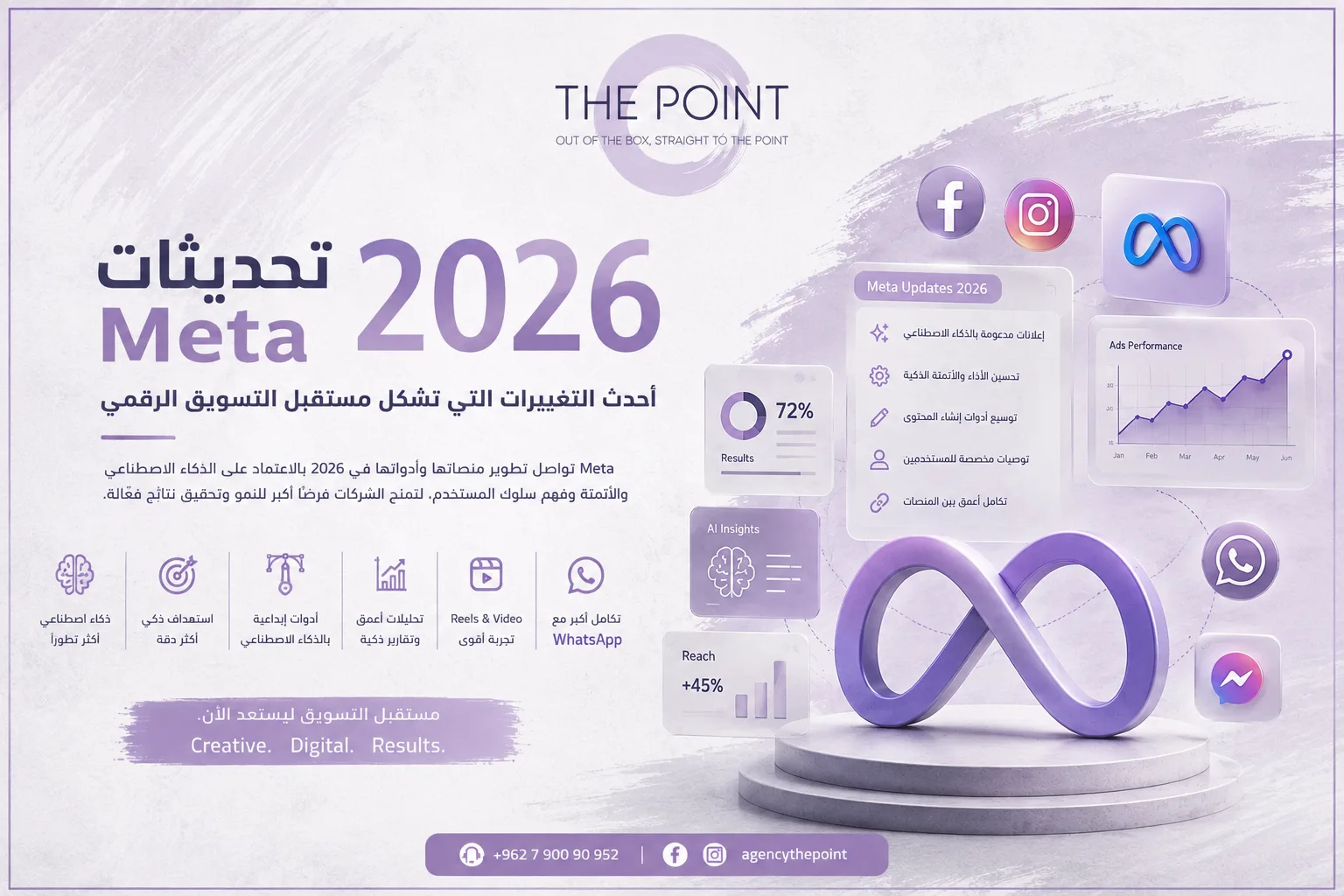
2026 is witnessing a significant transformation in the way the Meta ecosystem operates. The platform is no longer relying solely on traditional audience targeting; instead, it is increasingly driven by artificial intelligence, automation, user behavior insights, and content and advertising analysis.
From Facebook and Instagram to WhatsApp, Threads, and Meta AI, Meta is moving toward a more AI-driven marketing ecosystem. This means the rules of content creation and advertising campaign management are changing significantly.
In this article, THE POINT AGENCY highlights the key Meta updates that matter most to businesses, brands, and marketers in 2026 — and what needs to change in digital marketing strategies.
- AI Has Become a Core Part of Meta Ads
One of the biggest shifts in 2026 is Meta’s expanded use of artificial intelligence across its advertising ecosystem.
AI is no longer limited to improving audience targeting. It is increasingly being used for ad creation, performance analysis, creative testing, and budget optimization.
Meta is encouraging advertisers to provide the system with a wider range of creative options, allowing AI to test different combinations and identify which ones deliver the best results.
This highlights the growing importance of Creative Diversification — rather than relying on a single design or video, brands should provide a variety of creative ideas, messages, and angles.
What does this mean for advertisers?
Instead of saying:
“We have one ad and want to reach the best audience.”
The stronger approach is now:
“We have multiple creative ideas, and we want to give the system enough flexibility to determine what works best.”
This makes content quality and creative variety increasingly important to campaign performance.
- Meta AI Is Moving Into Business Management
In August 2026, Meta announced a new set of Meta AI tools designed to support small businesses.
Meta AI can increasingly use business-specific context, such as engagement data and advertising campaign information, to help answer questions about business performance.
Meta is also moving toward AI tools that can analyze Instagram and Facebook accounts and advertising campaigns, provide recommendations on content and performance, and assist with creating documents, presentations, and regular reports.
This represents an important shift:
From using AI simply to create content → to using AI as an actual marketing management assistant.
- The Goal Is No Longer “One Perfect Ad”
One of the most important changes marketers need to understand in 2026 is Meta’s increasing reliance on systems that continuously compare, test, and optimize creative content.
As a result, producing 10 different ads may be more effective than creating one ad and trying to optimize it for weeks.
Creative variation does not simply mean changing the design.
It can mean changing:
The concept
The Hook
The headline
The message
The audience
The visual style
The video length
The CTA
The problem being addressed
The way the product is presented
This shifts the role of the designer and marketer from creating a single advertisement to building a Creative Testing System.
- Content Is Becoming More Important Than Targeting Alone
For years, the main question in advertising was:
Who is our target audience?
In 2026, another question has become equally — and perhaps more — important:
Can our content stop the user, capture their attention, and convince them to take action?
AI is becoming increasingly capable of improving content distribution, but it cannot compensate for weak content or an unclear message.
That is why a strong strategy should operate across three levels:
Hook → Value → Action
Meaning:
Capture attention.
Deliver clear value or a solution.
Encourage the user to take action.
- Meta Is Moving Toward a Deeper Understanding of User Behavior
In June 2026, Meta announced changes related to how information shared by businesses can be used to improve the personalization of content users see, including their Feed and AI interactions, alongside advertising.
This reflects an important direction:
Meta does not simply want to know which user is likely to click an ad.
It wants to better understand context, interests, and behavior.
For brands, this means building a comprehensive digital presence is becoming increasingly important rather than relying on individual advertising campaigns.
- Instagram and Reels Remain at the Heart of Content Strategy
Short-form video continues to be one of the most important content formats on Instagram.
But competition in 2026 is significantly higher.
Simply producing a high-quality video is no longer enough.
Brands need:
A strong opening within the first few seconds
A clear story
Fast and appropriate editing
On-screen text
Consistent visual identity
Shareable content
Creative variety
Continuous Hook testing
Instagram also continues to introduce new features and updates related to Reels and content creation, making it essential for Social Media Managers to stay up to date with platform changes.
- AI Does Not Mean the End of Creativity
Quite the opposite.
At THE POINT AGENCY, we believe that as AI becomes more capable of handling technical tasks, the creative idea becomes even more valuable.
AI can help with:
Idea generation
Data analysis
Draft writing
Creating variations
Performance analysis
Accelerating production
But brands still need people who understand:
Audience + Market + Culture + Identity + Message
This is where creative agencies create real value — not by treating AI as a replacement for creativity, but as a tool to enhance and accelerate it.
What Should Businesses Do in 2026?
From the perspective of THE POINT AGENCY, there are five essential steps:
01 — Produce More Diverse Content
Do not rely on a single design or video.
Build a content library that can be continuously tested and optimized.
02 — Focus on the Creative
A successful advertisement starts with a strong idea, not simply with setting up a campaign inside Ads Manager.
03 — Use AI Strategically
Use AI tools to accelerate research, analysis, and production — while maintaining the human and creative identity of your brand.
04 — Analyze Results Continuously
Do not focus only on Likes and Reach.
Monitor:
CTR – CPC – CPA – ROAS – Conversion Rate – Retention
Most importantly, connect these metrics to your actual business objectives.
05 — Never Stop Testing
What works today may not work a month from now.
That is why:
Test → Learn → Optimize → Scale
should become a permanent part of your marketing strategy.
Conclusion
2026 is not simply another year in the world of social media.
It represents a transition for Meta from an ecosystem that relied heavily on manually configured campaigns toward one increasingly driven by artificial intelligence, automation, and continuous optimization.
As Meta expands its AI tools for businesses and advertisers, brands need to rethink how they approach content and advertising.
The question is no longer:
“How many ads are we going to publish?”
It is:
“How many creative ideas can we test — and what are the data telling us?”
At THE POINT AGENCY, we believe the future belongs not to brands that use the greatest number of tools, but to brands that know how to combine creativity, data, and artificial intelligence to create real results.
THE POINT AGENCY
Creative. Digital. Results.